
 Interior Waterproofing
 Exterior Waterproofing
 Masonry
 Other services
Summary:
Why Yard Ponding on Long Island Isn't Just an Eyesore
That puddle sitting in your yard three days after it rained isn’t just killing your grass. It’s showing you exactly where water wants to go—and if it’s pooling near your foundation, you’re looking at a problem that gets more expensive the longer you wait.
Long Island’s clay-heavy soil doesn’t absorb water the way sandy soil does. When rain hits, it either runs off or sits on the surface. If your property doesn’t have the right slope, that water collects in low spots, saturates the ground around your foundation, and eventually finds its way into your basement.
The real issue isn’t the puddle you can see. It’s the hydrostatic pressure building up against your foundation walls, the moisture seeping through microscopic cracks, and the long-term damage happening below ground while you’re trying to squeegee water off your basement floor.
What Actually Causes Yard Flooding After Rain in Nassau and Suffolk Counties
Your yard floods because water follows gravity, and right now, gravity is sending it toward your house instead of away from it. Most Long Island homes were graded correctly when they were built. But decades of settling, landscaping changes, and weather have altered those original slopes.
Here’s what happens: Your house sits on a foundation that was backfilled with soil when construction finished. Over 10, 20, or 30 years, that backfill settles. The soil compacts. What used to slope away from your foundation now slopes toward it. Add Long Island’s clay soil that sheds water instead of absorbing it, and you’ve created the perfect conditions for yard ponding and basement moisture.
Coastal storms make it worse. When nor’easters dump inches of rain in hours, even marginally adequate drainage fails. Spring brings its own challenges—snowmelt combines with seasonal rainfall to overwhelm systems that might handle normal conditions. Your yard can’t drain fast enough, water backs up, and it finds the path of least resistance straight to your foundation.
The problem compounds itself. Standing water kills grass. Dead spots become even more compacted. More water pools there next time. The cycle continues until you either fix the grading or deal with water in your basement.
Most homeowners try DIY solutions first. You add topsoil to low spots. You extend your downspouts. You seal basement cracks. These might help temporarily, but they’re treating symptoms, not causes. The water is still flowing toward your house—you’re just trying to block it after it arrives instead of redirecting it before it gets there.
Professional yard grading fixes the root problem by reshaping your property’s surface to create proper drainage slopes. It’s not complicated in concept: establish a consistent grade that moves water away from your foundation and toward appropriate drainage points. The execution, though, requires equipment, expertise, and an understanding of how Long Island’s specific soil conditions affect drainage.
How Poor Yard Grading Leads to Foundation and Basement Water Problems
Water sitting against your foundation doesn’t just stay there politely. It creates hydrostatic pressure—essentially, the weight of water pushing against your foundation walls. Concrete is porous. Even “waterproof” foundations have microscopic pathways that water can exploit when there’s enough pressure behind it.
That’s how you end up with damp basement walls, water seeping through floor-wall joints, or full flooding during heavy storms. The water outside is looking for a way in, and pressure gives it the force it needs to find weaknesses in your foundation.
Long Island’s clay soil makes this worse. Clay doesn’t drain. When water saturates clay soil around your foundation, it stays saturated. That constant moisture creates constant pressure. In winter, that moisture freezes and expands, creating even more force against your foundation walls. Freeze-thaw cycles can turn small cracks into significant structural problems over time.
Foundation damage from poor drainage isn’t always dramatic. You might not see catastrophic flooding. Instead, you notice a musty smell in the basement. You see efflorescence—those white, chalky deposits on concrete walls that indicate water is moving through the material. You find mold growing in corners. Your basement feels damp even when it’s not raining.
These are early warning signs that your drainage is failing. Ignore them long enough, and you’ll face foundation cracks, bowing walls, or basement flooding that requires emergency waterproofing. Those repairs cost $5,000 to $15,000 or more. Water damage claims average $15,400. Foundation work can run into tens of thousands.
Proper yard grading prevents all of this by keeping water away from your foundation in the first place. It’s the first line of defense in any comprehensive waterproofing strategy. Interior drainage systems and sump pumps are backup plans for water that gets past your exterior defenses. But if your grading is right, most water never makes it to your foundation at all.
The standard for Long Island properties is a 5-6% grade slope—about six inches of drop for every ten feet of distance from your foundation. That slope needs to be consistent, not just in one spot. Water needs a clear path away from your house on all sides. Low spots, reverse slopes, or flat areas create problems.
Getting that right requires more than dumping some topsoil near your foundation. You need to understand where water is coming from, where it needs to go, what type of soil to use (clay-rich near the foundation for water transport, quality topsoil on top for grass growth), and how to compact and stabilize the new grade so it doesn’t just settle back into the same problem.
Yard Regrading Cost Long Island: Why Your Tax Refund Covers It
Professional yard grading for a typical Long Island property runs $500 to $5,000 depending on the scope of work. Most homeowners spend $1,500 to $3,000 to regrade around their foundation and address major drainage issues. That’s right in the range of average tax refunds.
The timing works too. Tax refunds typically arrive February through April—exactly when you want to schedule grading work. Spring is ideal because the ground has thawed, but you’re getting ahead of heavy spring rains and summer storms. You fix the problem before the next weather event tests your drainage.
Compare that $1,500-$3,000 investment to what you’re preventing: foundation repairs ($5,000-$15,000), emergency basement waterproofing ($3,000-$15,000), water damage claims ($15,400 average), or the property value hit from trying to sell a house with known water problems. Grading isn’t an expense—it’s insurance against much larger costs down the road.
What Affects Foundation Grading Service Costs in Nassau and Suffolk Counties
Several factors determine what you’ll pay for professional landscape leveling on Long Island. Understanding these helps you budget accurately and recognize what’s driving the price.
Property size matters most. A small area around one side of your foundation costs less than regrading your entire yard. Contractors typically price by square footage ($0.40-$2.00 per square foot), by the hour ($40-$180 per hour with equipment), or by project scope.
Your current drainage situation affects cost. Minor grading adjustments to correct a slight slope problem cost less than major reshaping when water is pooling in multiple areas. If your yard has significant elevation changes or you need extensive excavation, expect higher costs.
Soil conditions play a role. Long Island’s clay soil can be difficult to work with, especially when saturated. If contractors need to bring in additional fill dirt or remove and replace soil, that adds to the project. Clay-rich soil for near-foundation areas costs more than standard fill dirt.
Access and obstacles impact pricing. If equipment can easily reach all work areas, the job goes faster and costs less. Tight spaces, landscaping that needs protection, underground utilities, or other obstacles slow work and increase labor costs.
Scope of work matters. Are you just regrading, or do you also need French drains, catch basins, dry wells, or other drainage infrastructure? Comprehensive solutions that address multiple water sources cost more upfront but provide better long-term protection.
Season and demand affect pricing. Spring and fall are busy seasons for drainage work on Long Island. Winter and summer might offer better availability and pricing, though winter work can be limited by frozen ground and summer by saturated soil from storms.
Most importantly, expertise affects cost. The cheapest bid often comes from contractors who will scrape some dirt around your foundation and call it done. Proper grading requires understanding drainage patterns, soil types, proper slopes, compaction techniques, and how to create stable grades that won’t settle. You’re paying for knowledge as much as labor.
For Long Island homeowners, the sweet spot is usually $1,500-$3,000 for comprehensive foundation grading that addresses the primary water sources threatening your basement. That’s enough to bring in professional equipment, reshape problem areas, establish proper slopes, and use appropriate soil mixtures that will last.
Professional Landscape Leveling vs DIY: Why Heavy Equipment Matters
You can’t fix significant grading problems with a shovel and a wheelbarrow. Physics won’t let you. Professional yard regrading requires moving cubic yards of soil, establishing precise slopes, and compacting material so it doesn’t just settle back into the same problem. That requires heavy equipment.
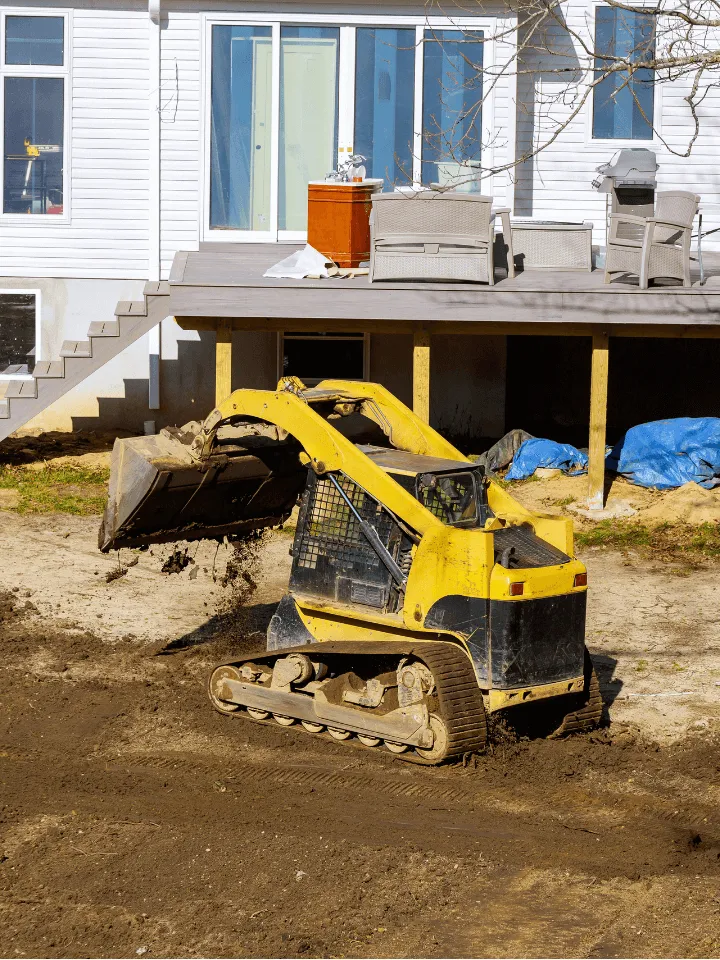
Contractors use skid steers, bobcats, mini excavators, and laser-guided grading equipment to reshape your property. These machines can move in hours what would take you weeks by hand. More importantly, they can establish and maintain the precise slopes necessary for proper drainage.
Laser levels ensure accuracy. Your eye can’t tell the difference between a 3% slope and a 6% slope, but your drainage can. That difference determines whether water moves away from your foundation efficiently or pools in spots that look level to you but aren’t.
Compaction matters as much as slope. Loose soil settles. If contractors just pile dirt near your foundation without proper compaction, that soil will compact naturally over the next year, and you’ll be back to the same negative slope you started with. Professional equipment includes compactors that stabilize the new grade.
Soil selection requires knowledge. You can’t just buy topsoil from the garden center and expect it to work. Near your foundation, you want less porous, clay-rich soil that transports water away efficiently. On top of that, you need quality topsoil that supports grass growth. The wrong soil in the wrong place undermines the entire project.
Understanding drainage patterns separates professionals from DIYers. Water doesn’t just flow straight downhill—it follows the path of least resistance, which includes soil composition, surface features, and existing drainage infrastructure. Professionals assess your entire property to understand where water is coming from and where it needs to go. They create grading plans that work with your property’s specific conditions.
Long Island’s unique challenges—clay soil, high water tables, coastal weather, freeze-thaw cycles—require local expertise. A contractor who understands these conditions knows what works and what fails. They’ve seen what happens to different approaches after a nor’easter or a freeze-thaw cycle. That experience prevents expensive do-overs.
DIY grading attempts usually fail in one of several ways: insufficient slope that doesn’t move water effectively, improper soil that settles or doesn’t drain, lack of compaction that leads to settling and slope reversal, or failure to address the full scope of the drainage problem. You might fix one area while creating new problems elsewhere.
The cost difference between DIY and professional work isn’t as large as you might think. By the time you rent equipment, buy materials, spend weekends on the project, and potentially redo mistakes, you’re not far from professional pricing. And you don’t get a warranty on your own work.
Professional foundation grading service includes assessment, planning, proper equipment, appropriate materials, expert execution, and warranty protection. When contractors finish, your drainage works. When storms come, water flows away from your house. That peace of mind is worth more than the difference between DIY and professional costs.
For most Long Island homeowners, professional landscape leveling is the right choice. The equipment requirements alone put it beyond reasonable DIY scope. Add the expertise needed to create lasting solutions, and it becomes clear why this is one home improvement that pays to hire out.
Making Your Tax Refund Work for Your Home's Long-Term Protection
Your tax refund gives you a chance to solve a problem that’s only getting worse. Every storm that sends water toward your foundation instead of away from it increases the risk of basement flooding, foundation damage, and expensive emergency repairs. Every spring thaw that saturates the ground around your house adds to the hydrostatic pressure threatening your basement walls.
Professional yard grading stops that cycle. It redirects water before it becomes a problem. It protects your foundation from the constant pressure that creates cracks and leaks. It eliminates the yard ponding that makes your outdoor space unusable and kills your landscaping.
The investment makes sense financially. You’re spending $1,500-$3,000 now to prevent $10,000-$30,000 in future foundation and waterproofing repairs. You’re protecting your property value—homes with known water problems are nearly impossible to sell without significant price reductions. You’re creating a yard you can actually use instead of watching puddles sit for days after every rain.
For Nassau and Suffolk County homeowners dealing with poor yard drainage, foundation water concerns, or recurring basement moisture, professional grading isn’t optional—it’s essential. Long Island’s clay soil, coastal weather, and flat terrain create drainage challenges that require proper solutions, not temporary fixes.
If you’re ready to use your tax refund strategically and solve your yard flooding problem permanently, we bring 25 years of Long Island experience to every project. We understand how Nassau and Suffolk County properties drain, what works in local soil conditions, and how to create grading solutions that last.