Managing Steep Hill Runoff in North Shore Homes

Summary:

Homes in Huntington, Port Washington, and Northport face a waterproofing challenge most Long Island properties don’t: steep terrain that sends water straight toward foundations. When gravity works against you, standard solutions often fail. This guide explains how hillside geography increases hydrostatic pressure on the uphill side of your foundation—and which exterior membranes and drainage systems actually handle the load. If you’re tired of water winning, here’s what works.
Table of contents
Your basement floods after every storm. Water seeps through the uphill wall. And every contractor you’ve called either quotes you a fortune or suggests a band-aid fix that won’t last past next spring. If your home sits on one of the North Shore’s rolling hills—Huntington, Port Washington, Northport—you already know the problem isn’t just water. It’s gravity. It’s pressure. It’s the fact that your foundation is holding back a hillside that wants to move downward every time it rains. You’re not looking for theory. You need to understand what’s actually happening underground, why it keeps happening, and what kind of system can handle the force of water running downhill. Let’s walk through it.

How North Shore Geography Creates Basement Water Problems

The North Shore isn’t flat. Port Washington sits on the Harbor Hill Moraine—a ridge of glacial deposits left behind thousands of years ago. Beacon Hill reaches 270 feet in elevation. Huntington and Northport have similar terrain. Hills, slopes, and uneven lots are the norm, not the exception.

That topography looks great from your living room window. But underground, it creates a constant battle between your foundation and the water flowing downhill. Every rainstorm sends runoff straight toward the lowest point, which is often the base of your home. And if your house sits partway up or at the bottom of a slope, that water doesn’t just pass by. It pools, it presses, and it finds a way in.

This isn’t a Long Island-wide issue. South Shore homes deal with high water tables and coastal flooding. But North Shore properties face a different problem: gravity-driven water pressure that doesn’t let up. Basement waterproofing in Nassau County and Suffolk County requires different strategies depending on whether you’re dealing with coastal flooding or hillside runoff.

Why Gravity Increases Hydrostatic Pressure on Uphill Foundations

Hydrostatic pressure is the force water exerts when it’s standing still or moving through saturated soil. On flat ground, that pressure distributes evenly around your foundation. But on a slope, the uphill side of your foundation takes the brunt of it.

Here’s why. When it rains, water doesn’t just sit on the surface. It soaks into the soil and moves downward, following gravity. If your home is built into a hillside, all that water is traveling toward the uphill side of your foundation. The soil behind that wall becomes saturated. The weight of the water-logged soil pushes against the concrete. And because gravity is pulling everything downhill, the pressure keeps building until the water finds a crack, a seam, or a porous section to seep through.

Think of it like a dam. Your foundation wall is holding back a hillside of wet soil. The steeper the slope, the more water flows toward it. The more water that accumulates, the greater the pressure. And unlike a dam, your foundation wasn’t designed to hold back a river. It was designed to support your house, not resist thousands of pounds of lateral force from saturated soil pressing inward.

This is why homes on slopes see water intrusion on the uphill side first. It’s not a drainage problem at the footer. It’s not a crack that appeared out of nowhere. It’s physics. The water is being forced through the wall by the sheer weight and pressure of the hillside behind it.

And here’s the part most homeowners don’t realize until it’s too late: sealing the cracks from the inside doesn’t solve this. You’re not stopping the pressure. You’re just forcing the water to find another way in. The only way to actually manage this is to address it on the exterior, where the water is coming from.

What Happens When Runoff Isn't Managed on Sloped Properties

Unmanaged runoff doesn’t just cause wet basements. It destabilizes your foundation over time. When water repeatedly saturates the soil on the uphill side of your home, that soil expands. When it dries out, it contracts. This cycle weakens the ground supporting your foundation and creates movement. Cracks appear. Walls bow. Floors become uneven.

On top of that, water that pools against your foundation doesn’t just press inward. It also works its way down to the footing—the base of your foundation that sits below ground. Once water reaches the footing, it can undermine the soil beneath it, causing settlement. That’s when you start seeing diagonal cracks in your basement walls, doors that won’t close properly, and gaps between the floor and the baseboard.

Erosion is another issue. If water is running down the slope and hitting your foundation, it’s carving channels in the soil. Over time, this creates low spots where even more water collects. You end up with a cycle: water flows toward your foundation, erodes the soil, creates a depression, and then even more water flows into that depression during the next storm. It compounds.

And let’s not forget what happens inside your basement. Chronic water intrusion leads to mold, musty odors, damaged belongings, and air quality issues that affect your entire home. If you have a finished basement, you’re looking at ruined drywall, flooring, and insulation. If it’s unfinished, you’re still dealing with an environment that’s damp, unhealthy, and steadily compromising the structural integrity of your home.

The longer this goes unaddressed, the more expensive the fix becomes. What starts as a waterproofing issue can turn into a foundation repair project. And foundation repair in Nassau or Suffolk County isn’t cheap, especially when access is limited by slopes, landscaping, or neighboring properties.

This is why North Shore homeowners need to think about waterproofing differently than someone with a flat yard in Levittown. The stakes are higher. The forces at play are stronger. And the solutions need to be engineered for the specific challenges of sloped terrain.

Exterior Waterproofing Solutions That Handle Slope Pressure

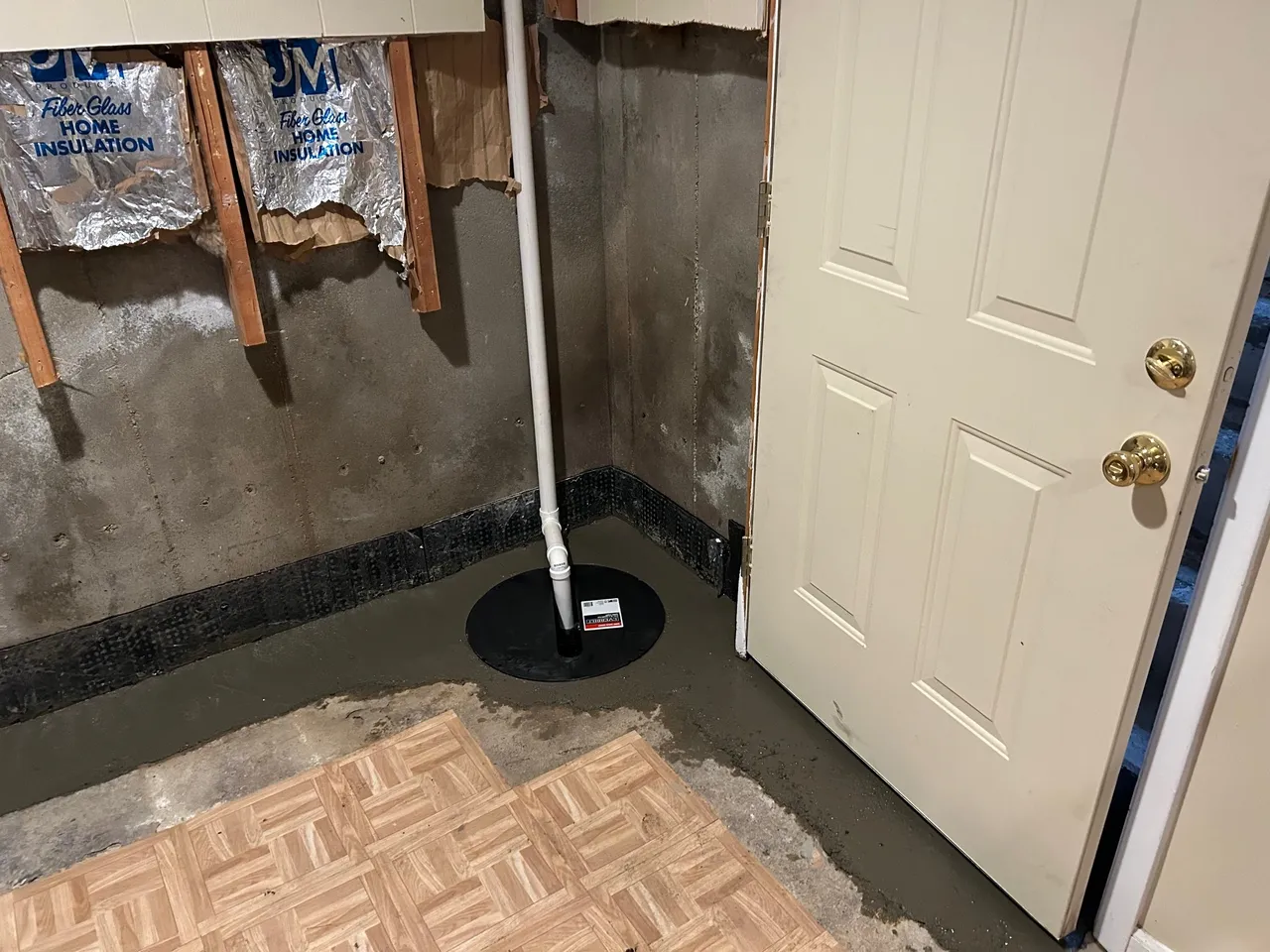
If your home is on a slope, interior waterproofing alone won’t cut it. Sump pumps and interior drains can manage water that’s already inside, but they don’t stop the pressure building up on the exterior. To actually protect your foundation from hillside runoff, you need to intercept the water before it reaches the wall.

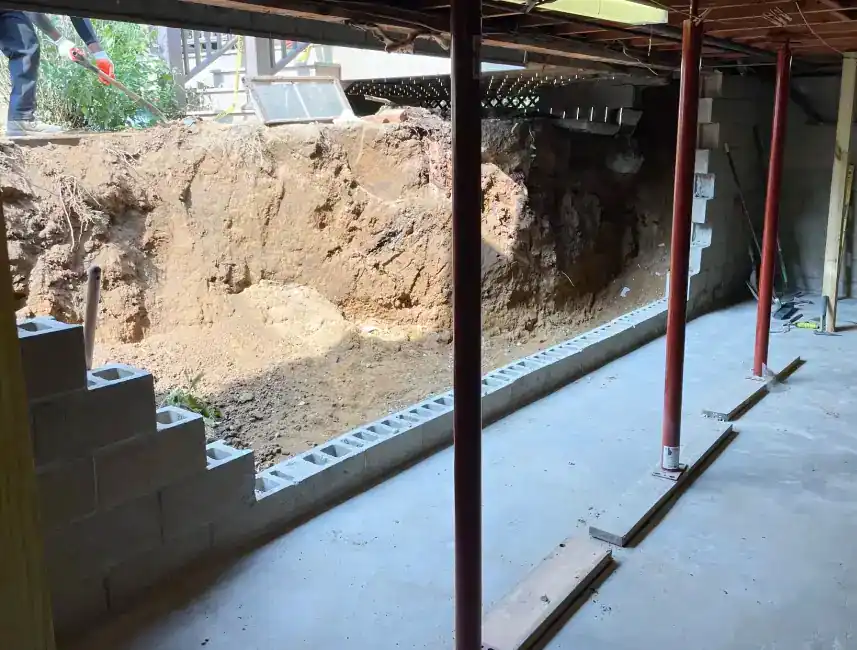
That means working on the outside. And yes, that means excavation. There’s no way around it. But when it’s done right, exterior waterproofing provides a level of protection that interior systems simply can’t match. You’re not just managing water. You’re redirecting it, relieving the pressure, and giving your foundation a fighting chance against gravity.

The two most effective components for sloped properties are exterior waterproofing membranes and deep-trench French drains. These work together to create a system that handles both water and pressure.

Exterior Waterproofing Membranes for Hillside Foundations

An exterior waterproofing membrane is a physical barrier applied directly to the outside of your foundation wall. It’s not paint. It’s not a coating that wears off in five years. It’s a durable, flexible material—often rubberized asphalt, polymer-based sheets, or HDPE (high-density polyethylene)—that creates a watertight seal between your foundation and the saturated soil pressing against it.

Here’s how it works. After excavation, the foundation wall is cleaned and inspected. Any cracks or voids are filled. Then a primer is applied to ensure proper adhesion. The membrane is installed in overlapping sections, covering the entire exterior surface from the footing up to just below grade level. Seams are sealed. Corners are reinforced. The result is a continuous, monolithic barrier that water can’t penetrate.

What makes this effective on slopes is that the membrane doesn’t just block water. It also benefits from the pressure. When hydrostatic pressure pushes water against the membrane, it actually presses the membrane tighter against the foundation wall, improving the seal. This is called positive-side waterproofing, and it’s the gold standard for below-grade applications.

But the membrane alone isn’t enough. If water is constantly pressing against it, you still have hydrostatic pressure building up. That’s where drainage comes in. The membrane needs to work in tandem with a system that relieves the pressure by giving the water somewhere to go. That’s the job of the French drain.

Membranes also protect the foundation from more than just water. They prevent soil acids, salts, and chemicals from degrading the concrete over time. They create a buffer between your home and the hillside. And when installed correctly, they last decades—far longer than any interior sealant or DIY waterproofing product you’ll find at the hardware store.

For homes in Huntington, Port Washington, or Northport, where slopes are steep and water pressure is constant, an exterior membrane is the first line of defense. It’s not the cheapest option upfront. But it’s the one that actually works when gravity is working against you.

Deep-Trench French Drains for Slope Drainage

A French drain is a gravel-filled trench with a perforated pipe at the bottom. Its job is to collect water and carry it away from your foundation. On a sloped property, a deep-trench French drain installed along the uphill side of your home intercepts runoff before it ever reaches the foundation wall.

Here’s the setup. The trench is dug down to the level of the footing—sometimes deeper, depending on the slope and soil conditions. It runs parallel to the foundation on the uphill side, and often wraps around the corners to cover any vulnerable areas. The trench is lined with filter fabric to prevent soil from clogging the system. Then it’s filled with clean, angular gravel (not round river rock, which doesn’t drain as well). A perforated pipe is placed at the bottom of the trench, with the holes facing down. More gravel goes on top, and the fabric is wrapped over the whole thing before backfilling with soil.

When water flows down the hillside, it hits the trench. Instead of continuing toward your foundation, it drops into the gravel, filters down to the pipe, and flows through the pipe to a discharge point—either a daylight drain at the bottom of your property, a dry well, or a sump pump system if the slope doesn’t allow for gravity drainage.

The key to making this work on steep terrain is depth and placement. The drain needs to be deep enough to intercept subsurface water, not just surface runoff. And it needs to be positioned uphill from the foundation, so it catches the water before pressure builds up against the wall. Shallow drains or drains placed too close to the foundation won’t relieve the hydrostatic pressure. They’ll just manage water that’s already pooled at the base of the wall, which is too late.

On properties with multiple levels or terraced slopes, you might need more than one French drain. A system of drains at different elevations can intercept water at each level and move it downhill in a controlled way, preventing it from concentrating at any single point. This is especially important in areas like Northport or Port Washington, where homes are built into hillsides with significant elevation changes.

French drains also need to be maintained. Over time, silt and sediment can work their way into the gravel and clog the pipe. That’s why the filter fabric is critical. But even with fabric, it’s smart to have the system inspected every few years, especially after major storms. A clogged French drain is almost as bad as no drain at all—it gives you a false sense of security while water is quietly building up behind it.

When combined with an exterior waterproofing membrane, a deep-trench French drain creates a complete system. The membrane blocks water from penetrating the foundation. The drain relieves the pressure by giving the water an escape route. Together, they handle the forces that gravity and hillside runoff throw at your home.

Protecting Your Foundation from North Shore Runoff

Living on a slope comes with challenges that flat properties don’t face. Gravity amplifies water pressure. Runoff concentrates at your foundation. And every rainstorm tests whether your waterproofing system is up to the job.

The solution isn’t a quick fix or a product you spray on the inside of your basement wall. It’s a properly engineered exterior system—membranes to block water, French drains to relieve pressure, and installation that accounts for the specific slope, soil, and drainage patterns of your property. That’s what actually works when your foundation is holding back a hillside.

If you’re dealing with water intrusion on the uphill side of your home, or if you’ve tried interior solutions that didn’t solve the problem, it’s time to look at what’s happening on the outside. We’ve been handling these exact challenges in Nassau and Suffolk Counties for over 25 years. We understand North Shore terrain, and we know how to build systems that stand up to it.