
 Interior Waterproofing
 Exterior Waterproofing
 Masonry
 Other services
Summary:
Why Freeport and South Shore Basements Flood After Winter
Long Island sits on a high water table. That’s not news to anyone who’s lived here long enough. But Freeport and the South Shore communities face conditions that make post-winter flooding almost inevitable without proper drainage systems.
The Atlantic Ocean sits on one side. Tidal influence pushes groundwater levels higher during certain moon phases. Add winter snowmelt to already saturated soil, and you’re looking at water with nowhere to go except up through your basement floor.
The geology compounds the problem. Sandy coastal soil drains differently than clay deposits found inland in Nassau County. Some neighborhoods built on former wetlands have water tables that sit just feet below the surface year-round. When spring arrives and temperatures swing from freezing to 50 degrees in a matter of days, the ground can’t absorb meltwater fast enough.
How Winter Snowmelt Creates Basement Water Pressure in Nassau County
Winter creates a perfect storm of conditions for basement flooding. Snow accumulates over weeks or months. The ground beneath it freezes. When temperatures finally rise, all that frozen precipitation melts rapidly.
Here’s the problem: frozen ground doesn’t absorb water. It acts like concrete. Meltwater hits the surface, can’t penetrate, and either runs off or pools until it finds another way down. That other way is often through the edges of your foundation, through floor joints, or directly through porous concrete.
Even without visible cracks, water finds its way in. Concrete is porous by nature. Under enough pressure, moisture moves through it molecule by molecule. You don’t see a dramatic flood. You see damp spots that grow larger. Puddles that appear in the same corner every March. A musty smell that never quite goes away.
The water table itself rises during spring thaw. All that meltwater eventually makes it into the ground, but when it does, it saturates soil that’s already holding near-maximum capacity. The water table can rise several feet in a matter of weeks. If your basement floor sits below that risen water table, you’re going to have problems.
South Shore communities see this pattern repeat every year. Residents in Freeport know to move storage off basement floors before the first warm spell. Homeowners in Bellmore and Wantagh have learned which corners flood first. This isn’t a random event. It’s predictable, geological, and manageable with the right approach.
The difference between a dry basement and a wet one often comes down to whether you have systems in place to handle hydrostatic pressure before it forces water through your foundation. Surface solutions like regrading or gutter extensions help with runoff, but they don’t address pressure from below. That requires interior drainage designed for high water table conditions.
What Hydrostatic Pressure Does to Your Foundation
Hydrostatic pressure is the force water exerts when it’s trapped against a surface. In your basement, that surface is your foundation walls and floor. When the water table rises above your basement floor level, water pushes against concrete from below and from the sides.
Concrete can handle compression. It’s designed for it. But it’s not designed to be waterproof under sustained pressure. Small pores and microscopic pathways exist throughout the material. Under enough pressure, water finds those pathways and moves through.
You see the results as seepage at the cove joint where your floor meets the wall. Or as dampness spreading across your basement floor after heavy rain. Or as cracks that appear to “weep” during spring months. That’s hydrostatic pressure at work.
Long Island’s high water table means you’re dealing with this pressure year-round, but it intensifies dramatically during winter snowmelt and spring rains. The water table can rise from 8 feet below your basement floor to 2 feet below it in a matter of weeks. That’s a massive increase in pressure against your foundation.
Traditional waterproofing approaches try to stop water at the foundation wall. They seal cracks, apply coatings, and install exterior membranes. Those solutions help with surface water, but they don’t relieve hydrostatic pressure. The water is still there, still pushing, still finding weak points.
Interior drainage systems take a different approach. Instead of trying to keep water out entirely, they give it a controlled path in and then remove it before it causes damage. A perimeter drain installed at the base of your foundation wall captures water as it enters, channels it to a collection point, and a sump pump removes it from your home entirely.
This approach works with geology, not against it. You’re not trying to create a waterproof box in saturated soil. You’re managing water movement in a way that protects your basement while acknowledging that water will always find a way to the lowest point.
For Freeport and South Shore homeowners, this distinction matters. You’re not dealing with occasional heavy rain. You’re dealing with a water table that rises and falls with seasons, tides, and weather patterns. Your drainage system needs to handle sustained pressure, not just isolated events.
Interior Drainage Systems for High Water Table Areas
Interior drainage systems work because they’re designed around a simple principle: water always flows to the lowest point. Instead of fighting that principle, you use it.
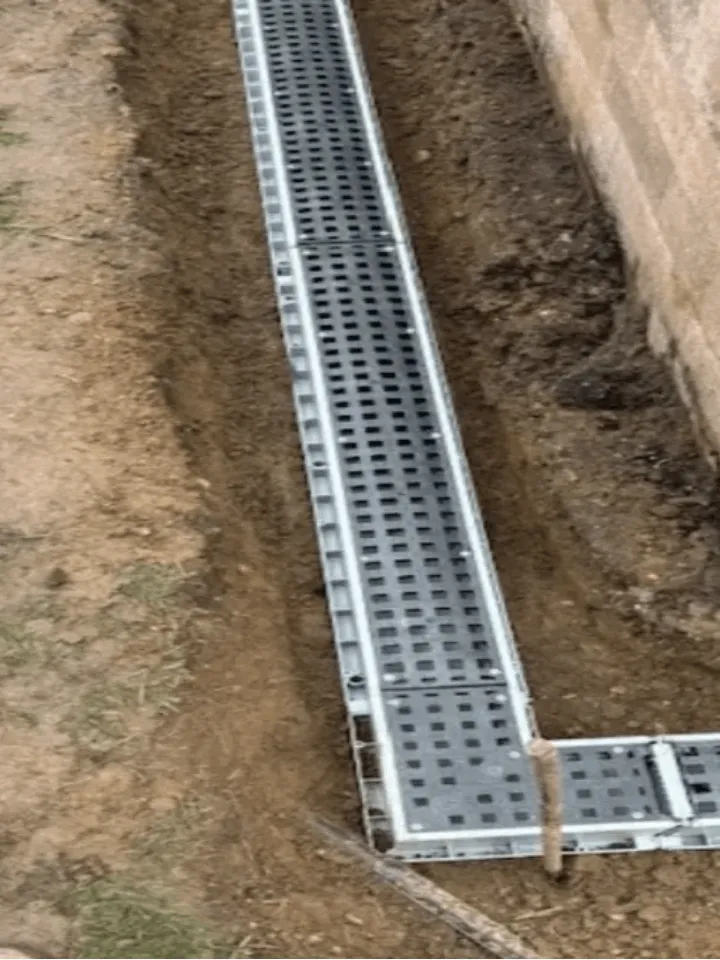
A perimeter drain is installed along the inside edge of your basement floor, right at the footing. It sits lower than your basement floor, creating a collection channel for any water that enters through the foundation. Perforated pipe allows water to flow in from all sides. Gravel surrounding the pipe provides filtration and prevents clogging.
The system slopes toward one or more collection basins where a sump pump is installed. When water reaches a certain level in the basin, the pump activates and pushes water out of your home entirely. It’s mechanical, reliable, and designed to handle the sustained water pressure that comes with a high water table.
Why Interior French Drains Outperform Exterior Waterproofing in Nassau County
Exterior waterproofing has its place. Excavating around your foundation, applying membranes, and installing exterior drainage boards all help manage water before it reaches your foundation walls. But exterior work doesn’t address water rising through your basement floor.
In high water table areas like Freeport and South Shore communities, water doesn’t just come through walls. It comes up through the floor at the cove joint. It seeps through porous concrete. It finds every microscopic pathway available when pressure builds.
Exterior waterproofing also requires massive excavation. You’re digging down to the footing around your entire foundation perimeter. That means heavy equipment, landscape disruption, and costs that can reach $20,000 to $30,000 for a typical Long Island home. And after all that work, you still haven’t addressed hydrostatic pressure from below.
Interior drainage systems install in days, not weeks. The work happens inside your basement, so there’s no excavation around your foundation, no landscape damage, and no need to coordinate with neighbors about equipment access. Most Nassau County basements need between 80 to 120 linear feet of drainage, with total costs typically running $6,000 to $10,000 depending on perimeter length and complexity.
More importantly, interior systems address the specific problem high water table areas face: pressure from below. The drain captures water at the exact point it enters, before it can spread across your floor or saturate your foundation walls. The sump pump provides active removal, handling water volume that gravity-based exterior drains simply can’t match.
This doesn’t mean exterior waterproofing is useless. In some situations, combining both approaches makes sense. But if you’re choosing one system to protect against post-winter flooding in a high water table area, interior drainage delivers better results for less money.
The system also offers flexibility. If you have specific areas where water enters, additional drainage can be installed at window wells, utility penetrations, or other vulnerable points. Everything ties into the same perimeter drain and sump pump system, creating comprehensive South Shore flood protection without requiring separate solutions for each problem area.
French Drain and Sump Pump Installation: What Actually Happens
Installing an interior drainage system involves breaking a channel around your basement perimeter, typically about 12 inches wide. The concrete is removed down to the footing level, creating space for the perforated drain pipe. Clean stone surrounds the pipe, allowing water to flow freely while filtering out debris.
The drain slopes toward a sump basin, usually installed at the lowest point of your basement. The basin holds water until it reaches a level that triggers the sump pump. The pump then forces water out through a discharge line that runs to a safe location away from your foundation.
Most installations take 2 to 3 days for a typical Long Island basement. The first day involves demolition and excavation. The second day is for installing the drainage system, sump pump, and backfilling with stone. The third day is for concrete restoration and cleanup.
You’ll need to clear the basement perimeter of storage and furniture. If your basement is finished, you’ll need to remove the bottom 3 to 4 feet of drywall and flooring along the walls where work is happening. We handle demolition and concrete work, but you’re responsible for clearing the space beforehand.
Dust is inevitable during concrete demolition, even with shop vacs and dust barriers. Turning off your HVAC system during the heaviest work prevents dust from circulating through your home. You’ll also want to cover any items that can’t be moved with plastic sheeting.
The sump pump requires a dedicated electrical outlet with GFCI protection. If you don’t have one near the installation location, an electrician will need to install it before the pump goes in. This is code in most areas and ensures the pump has reliable power when you need it most.
Battery backup systems are worth considering for Long Island homes. Spring storms that trigger flooding often come with power outages. A battery backup ensures your sump pump keeps running even when the power is out, providing protection when you need it most.
Discharge lines need to run far enough from your foundation that pumped water doesn’t simply recirculate back toward your basement. Most installations require at least 10 to 15 feet of separation. In some cases, the discharge ties into an existing drainage system or dry well. In others, it runs to the street or a lower area of your property.
Maintenance is minimal but important. Sump pumps should be tested annually by pouring water into the basin and confirming the pump activates. The basin itself should be cleaned of any sediment or debris that accumulates. The discharge line should be checked to ensure it’s not blocked by ice in winter or debris in other seasons.
Most quality installations come with warranties covering both workmanship and materials. This protects you if issues arise and demonstrates our confidence in the work. For a system designed to last decades, warranty coverage provides peace of mind that you’re not on your own if something goes wrong.
Protecting Your Home from Post-Winter Basement Flooding
High water tables aren’t going away. Spring snowmelt will continue raising groundwater levels every year. And basements in Freeport, Massapequa, Bellmore, Wantagh, and across South Shore Nassau communities will continue facing the same pressure from below.
The difference is whether you have systems in place to manage that pressure before it forces water into your living space. Interior drainage systems designed for Long Island’s specific geological conditions provide permanent protection. They work with the water table, not against it, capturing water at the point of entry and removing it before damage occurs.
You’re not just protecting your basement. You’re protecting your home’s value, your family’s health, and your peace of mind during every spring thaw and heavy rain. If you’re ready to stop dealing with post-winter flooding, we have the experience and proven solutions to keep your basement dry year-round.