
 Interior Waterproofing
 Exterior Waterproofing
 Masonry
 Other services
Summary:
What Makes Exterior Waterproofing Different from Interior Solutions
Interior waterproofing manages water after it’s already trying to get in. Exterior waterproofing stops it before it ever touches your foundation. That’s the fundamental difference, and it changes everything about how your basement stays dry.
When you waterproof from the inside, you’re essentially catching and redirecting water that’s already penetrated your foundation walls. Sump pumps, interior drains, vapor barriers—they all serve a purpose, but they’re reactive. Exterior membranes are proactive. They create an impenetrable layer between your foundation and the saturated soil pressing against it.
Think about how water behaves around your Long Island home. After a nor’easter or even a typical summer downpour, the soil around your foundation becomes saturated. That water doesn’t just sit there. It builds pressure—hydrostatic pressure—pushing against your basement walls, searching for any crack, any porous section of concrete, any weak point to exploit. Interior solutions can’t stop that pressure. They can only deal with the water once it breaks through.
How Hydrostatic Pressure Affects Long Island Foundations
Hydrostatic pressure is just water weight pushing against your foundation. But on Long Island, where the water table sits close to the surface and soil conditions vary wildly from one neighborhood to the next, that pressure becomes a constant threat.
Much of Nassau and Suffolk Counties sit just feet above the water table. After prolonged rain, groundwater rises quickly. In low-lying areas near the coast or along the South Shore, basements face pressure from multiple directions—not just from rain runoff, but from groundwater that has nowhere else to go.
Your foundation walls are concrete, and concrete is porous. Under enough pressure, water will find its way through. It might start as dampness, efflorescence (that white powdery residue), or a musty smell. Give it time, and you’ll see actual water seeping through cracks or along the cove joint where your walls meet the floor.
Interior waterproofing can’t relieve that external pressure. It can catch the water once it comes through, channel it to a drain, pump it out. But the pressure remains. The water keeps pushing. And over time, that constant force can cause cracks to widen, walls to bow, and structural problems to develop.
Exterior waterproofing membranes address the pressure itself. By creating a waterproof barrier on the outside of your foundation, they prevent water from ever making contact with the concrete. The membrane handles the pressure. Your foundation doesn’t have to.
This matters especially in areas with sandy soil, which is common across Long Island. Sandy soil drains differently than clay. It allows water to move laterally—sideways toward your foundation—rather than just percolating down. That lateral movement increases the surface area of your foundation that’s exposed to moisture and pressure. An exterior membrane protects the entire exterior surface, not just the spots where water happens to break through.
And then there’s the freeze-thaw cycle. Long Island winters aren’t as brutal as upstate, but temperatures still drop below freezing. When water-saturated soil freezes, it expands. That expansion puts enormous pressure on foundation walls—sometimes thousands of pounds of force. Interior systems can’t prevent that. Exterior membranes, especially flexible ones designed for temperature fluctuations, can handle the expansion without cracking or separating.
Why Exterior Membranes Last Longer in Coastal Conditions
Long Island’s coastal location creates a unique set of challenges. Salt air, high humidity, storm surge potential, and consistently damp conditions all accelerate deterioration. Materials that work fine in other parts of the country fail faster here. That’s why the type of exterior membrane you use matters as much as the decision to waterproof from the outside.
Commercial-grade exterior membranes designed for coastal environments are built to last. The best ones use materials like polyurethane or HDPE (high-density polyethylene) that resist UV degradation, don’t break down from salt exposure, and maintain flexibility across a wide temperature range. These aren’t the same materials used in standard dampproofing. They’re engineered for permanent protection.
Lifespan is a real consideration. A properly installed exterior membrane system can last 100 years. Interior solutions, by comparison, require ongoing maintenance. Sump pumps fail. Batteries die during power outages. Drainage channels can clog. Vapor barriers can develop gaps. You’re not just paying for installation—you’re committing to upkeep.
Exterior membranes, once installed, require virtually no maintenance. They’re buried and protected by backfill. They don’t have moving parts. They don’t rely on electricity. They just work, year after year, keeping water away from your foundation regardless of what’s happening above ground.
The installation process is more involved, yes. It requires excavation around your foundation down to the footing. The walls need to be cleaned and prepped. Any existing cracks or structural issues get addressed before the membrane goes on. Then the membrane is applied—either as a spray-on liquid that cures into a seamless barrier, or as sheet material that’s adhered to the foundation with overlapping seams sealed watertight.
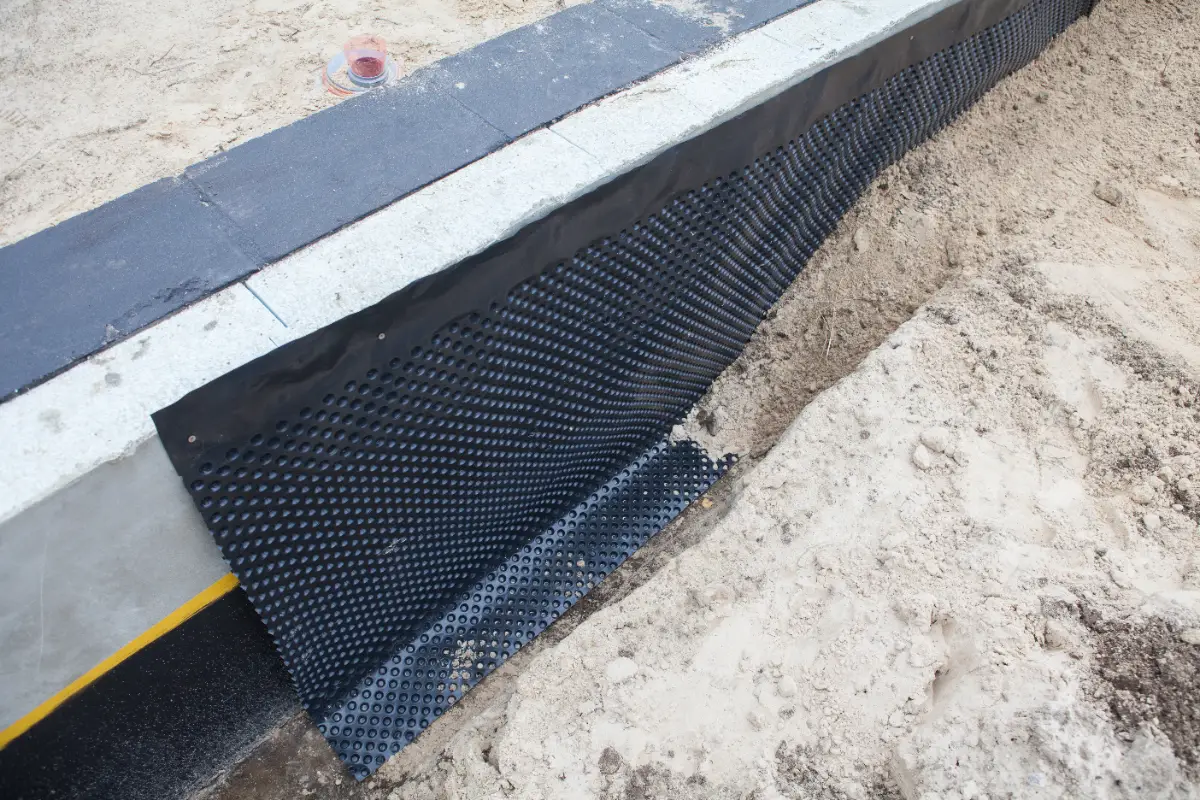
After the membrane is in place, a drainage layer typically goes on top. This could be a dimple mat or drainage board that creates a gap for water to flow down to the footing drain. The footing drain itself—often a perforated pipe surrounded by gravel—carries water away from the foundation to a discharge point or sump. Then everything gets backfilled.
It’s a bigger project than installing an interior drain. But you’re solving the problem once, correctly, rather than managing it indefinitely. For homes with serious groundwater issues, homes in flood-prone areas, or homes where the water table is high, exterior waterproofing isn’t just the better option. It’s often the only option that actually works long-term.
When Exterior Waterproofing Makes the Most Sense for Your Home
Not every basement needs exterior waterproofing. If you’re dealing with minor condensation or the occasional damp spot, interior solutions might be enough. But if you’re facing recurring flooding, visible water intrusion after every storm, or foundation cracks that keep coming back no matter how many times you seal them, exterior waterproofing is worth considering.
Homes built before modern waterproofing standards are prime candidates. Many older Long Island homes were constructed when builders simply applied a coat of tar to the foundation and called it waterproofed. That tar degrades. It cracks. It doesn’t handle hydrostatic pressure. If your home is 30, 40, 50 years old and you’re starting to see water problems, the original waterproofing has likely failed.
Location matters too. If you’re in a low-lying area, near the water, or in a neighborhood known for high water tables, exterior waterproofing provides the level of protection you need. Interior systems can help, but they’re fighting an uphill battle against constant pressure. Exterior membranes remove the pressure from the equation.
What the Installation Process Actually Involves
Exterior waterproofing is a major project, but understanding what’s involved helps you know what to expect and why it costs what it does.
First, the area around your foundation gets excavated. This means digging down to the footing—typically 8 to 10 feet deep—and exposing the exterior foundation walls. If you have landscaping, walkways, or anything else adjacent to the foundation, it may need to be temporarily removed or worked around.
Once the walls are exposed, they’re cleaned thoroughly. Any dirt, old waterproofing material, or debris gets removed. This step is critical. The membrane needs a clean, sound surface to adhere to. If the substrate isn’t properly prepared, the membrane won’t bond correctly, and you won’t get a watertight seal.
Next, any cracks or structural issues get repaired. This isn’t cosmetic. If there are cracks in your foundation, they need to be addressed before waterproofing. Otherwise, you’re just covering up a problem that will continue to worsen. Depending on the severity, repairs might involve epoxy or polyurethane injection, patching with hydraulic cement, or more extensive structural work.
After repairs, a primer is often applied. This helps the waterproofing membrane adhere better and ensures a consistent bond across the entire surface. Then the membrane itself goes on. Liquid-applied membranes are sprayed or rolled onto the wall and cure to form a seamless, flexible barrier. Sheet membranes are applied in overlapping sections with seams sealed to create a continuous waterproof layer.
Attention to detail matters here. Corners, transitions, penetrations (like where utility lines enter the foundation), and the area where the wall meets the footing all need special treatment. These are potential weak points. A quality installation ensures every inch is sealed.
Once the membrane is in place, a drainage layer is installed. This could be a dimple mat—a plastic sheet with raised bumps that create an air gap—or a foam drainage board. The purpose is to give water a path to flow down to the footing drain rather than sitting against the membrane.
The footing drain itself is either inspected and cleared (if one exists) or newly installed. This is typically a perforated pipe set in gravel at the base of the foundation. It collects water that makes it down to the footing level and carries it away to a safe discharge point—either to daylight if your property slopes, to a storm drain if code allows, or to a sump pit if neither option is available.
Finally, everything gets backfilled. The excavated soil goes back in, usually in layers that are compacted to prevent settling. Landscaping gets restored. And you’re left with a foundation that’s protected from the outside, the way it should have been from the beginning.
The whole process typically takes several days to a week, depending on the size of your home and the complexity of the job. Yes, it’s disruptive. Yes, it’s more expensive than interior waterproofing. But you’re getting a permanent solution that protects your foundation, prevents structural damage, and eliminates the recurring water problems that have been costing you time, stress, and money.
Choosing the Right Membrane for Long Island Soil and Climate
Not all waterproofing membranes are created equal. What works in Arizona won’t necessarily hold up in Long Island’s damp, freeze-thaw, salt-air environment. The membrane you choose needs to handle the specific conditions your foundation faces.
Flexible membranes are essential for Long Island. Sandy soil shifts. It expands when wet, contracts when dry. Rigid waterproofing systems crack when the ground moves. Flexible membranes—particularly those made from polyurethane or modified asphalt with rubberized additives—move with the soil without losing their seal.
Polyurethane membranes are applied as a liquid and cure into a seamless, rubber-like coating. They bond directly to the concrete, bridge hairline cracks, and remain flexible across a wide temperature range. They’re also resistant to root penetration, which matters if you have trees or shrubs near your foundation.
HDPE sheet membranes are another solid option. These are pre-formed plastic sheets that get applied to the foundation with adhesive or mechanical fasteners. They’re extremely puncture-resistant and don’t degrade from moisture or soil contact. The key with sheet membranes is ensuring every seam is properly sealed. Any gap becomes a potential leak point.
Bentonite clay membranes are sometimes used, particularly in commercial applications. Bentonite swells when it contacts water, forming a thick, impermeable barrier. It’s self-healing—if it gets punctured, the clay expands to fill the gap. However, bentonite requires careful installation. If it gets wet before backfilling is complete, it can expand prematurely and create problems.
For most Long Island residential applications, liquid-applied polyurethane or HDPE sheets are the go-to choices. They handle the local soil conditions, resist salt and moisture, and provide the long-term durability you need.
Drainage components matter just as much as the membrane itself. The best waterproofing membrane in the world won’t help if water has nowhere to go. That’s where the drainage layer and footing drain come in. Together, they create a system that not only blocks water but actively moves it away from your foundation.
Dimple mats are popular because they’re effective and relatively affordable. The raised dimples create an air gap between the membrane and the soil, giving water a clear path to drain down. Water that would otherwise sit against your foundation flows down to the footing drain instead.
Footing drains need to be sized correctly for Long Island’s soil and rainfall. In areas with heavy clay content or high water tables, a standard 4-inch perforated pipe might not be enough. Upgrading to a 6-inch pipe or adding additional drainage capacity ensures the system can handle peak flow during storms.
And don’t overlook the discharge point. If your footing drain empties into a sump pit, you need a reliable sump pump—preferably with battery backup for when power goes out during storms. If it drains to daylight or a storm sewer, make sure the outlet is clear and functioning. A clogged discharge point defeats the entire system.
Protecting Your Foundation from the Outside In
Interior waterproofing has its place. For minor moisture issues or situations where exterior access isn’t possible, it can be effective. But when you’re dealing with Long Island’s high water tables, coastal conditions, and soil that doesn’t drain predictably, exterior waterproofing membranes offer protection that interior systems simply can’t match.
They stop water before it reaches your foundation. They handle hydrostatic pressure instead of just managing its effects. And they last—decades, even a century—without the ongoing maintenance that interior systems require.
If you’re tired of recurring water problems, if you’re worried about foundation damage, or if you just want the peace of mind that comes with knowing your basement will stay dry no matter what the weather does, exterior waterproofing is worth the investment. We’ve been installing these systems across Nassau and Suffolk Counties for over 25 years, using materials designed specifically for Long Island’s unique challenges. The work gets done right, on time, and backed by a warranty that protects your investment for the long haul.